John Courtney Murray, Time/Life, and the American Proposition (Two Volumes)
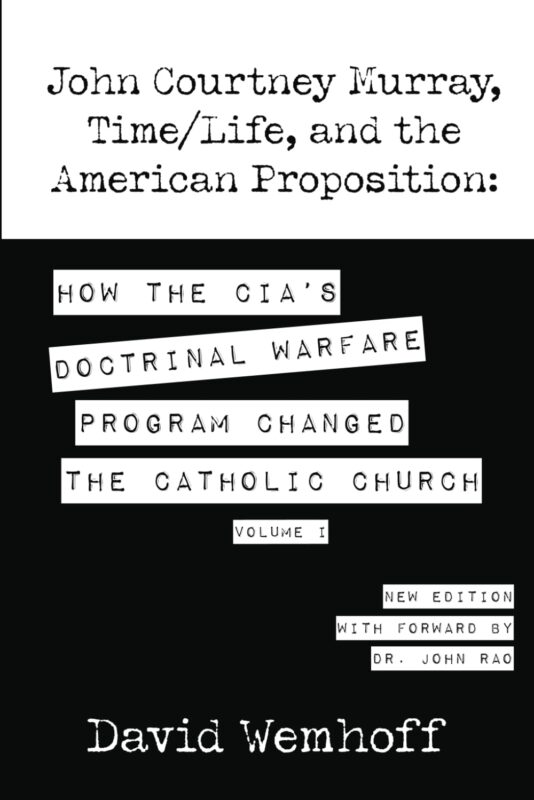
John Courtney Murray, Time/Life, and The American Proposition: How the CIA’s Doctrinal Warfare Program Changed the Catholic Church - Volume I by David Wemhoff reveals the mechanics of ideological transformation within the Catholic Church orchestrated by American elites, intelligence operatives, and media powerbrokers.
Engineering Consent Through Doctrine
Henry Luce shaped mid-century American consciousness with an unmatched command of media. He did not merely report news. He crafted narrative weapons, grounding psychological warfare in a moral framework favorable to American global aims. Luce saw American ideals—capitalism, liberal democracy, individualism—as universal truths requiring global dissemination. His Life and Time magazines created icons, enemies, and saints of ideology.
What required deeper calibration was the Church. The Vatican represented not only a global moral authority but a rival to the American ideological proposition. That proposition, articulated as a seamless synthesis of constitutional liberalism, market individualism, and religious freedom, demanded internalization. The CIA, seeking to secure this domestically and abroad, adopted a strategy of doctrinal warfare. The goal: infiltrate and redirect belief systems.
The American Century and Its Architect
Henry Luce’s formulation of the “American Century” codified the mission. His upbringing as the son of missionaries and his patrician education aligned him with imperial strategy clothed in moral terms. American society, for Luce, was the platform through which divine providence advanced history. The integration of Protestant ethics, corporate capitalism, and state power required legitimacy from the Catholic intellectual elite.
Luce deployed his wife, Clare Boothe Luce, a convert and U.S. Ambassador to Italy, as emissary and enforcer. Together, they established relationships with Church leaders, Vatican insiders, and theological innovators. Their presence in Rome in 1953, under the guise of diplomatic and cultural engagement, masked a deeper ambition: doctrinal convergence.
Murray’s Role as Doctrinal Architect
Jesuit priest John Courtney Murray offered the theological scaffolding for this convergence. His work translated American constitutional principles into Catholic theological categories. He reframed religious liberty as a positive good, not a reluctant concession. His participation in secret conferences organized by the National Conference of Christians and Jews, alongside media strategists and intelligence consultants, advanced this reinterpretation.
Murray’s project culminated in a proposal: that the Catholic Church endorse religious freedom as a universal human right grounded in natural law rather than as a circumstantial tolerance. This move rewired Church-state doctrine and positioned the Church as compatible with, rather than oppositional to, American liberal modernity.
Weaponizing Religious Freedom
The CIA’s doctrinal warfare program codified this strategy. Its internal documents identified religious institutions as critical battlegrounds. The plan included infiltration, funding, and media amplification of religious figures who supported American ideological goals. Faith traditions were not neutral cultural artifacts. They were engines of allegiance. The objective was not coexistence but strategic transformation.
Doctrinal warfare operated through think tanks, university partnerships, media alliances, and Vatican diplomacy. The strategy moved from abstract ideology to personnel. By supporting specific theologians and discrediting others, the program disciplined the range of acceptable religious discourse. It reshaped orthodoxy.
The Vatican Frontline
Rome responded unevenly. Cardinal Alfredo Ottaviani resisted. He upheld the traditional view that error has no rights and that the state must recognize the true religion. His confrontation with Murray and Americanists sharpened internal divisions. These were not arcane theological disputes. They revealed the stakes of sovereignty—whether moral authority resided with the Church or with secular liberalism.
Pope Pius XII attempted mediation. His encyclicals balanced acknowledgment of pluralistic conditions with affirmation of doctrinal integrity. But his ambivalence provided openings. Vatican bureaucracy, fractured and politically infiltrated, failed to enforce doctrinal coherence. Jesuit networks, often aligned with American interests, expanded their influence.
Media as Theological Battlefield
Luce’s magazines did more than reflect the debate. They structured it. Time introduced Murray to a broader audience as a courageous modernizer. Critics like Monsignor Joseph Fenton and Fr. Francis Connell, who defended pre-conciliar doctrine, found their influence marginalized. The media did not report doctrine; it selected protagonists and framed heresies as forward thinking.
This manipulation extended to academic institutions. Grants, publishing contracts, and public platforms privileged those aligned with the American Proposition. Dissent became equated with backwardness, isolationism, and even complicity with totalitarianism. The boundaries of theological debate were redrawn by editorial boards and strategic funding.
Strategic Convergence and Institutional Capture
The convergence was codified at Vatican II. Though presented as a pastoral council, its outcomes validated Murray’s core assertions. The declaration Dignitatis Humanae, often cited as evidence of continuity, in practice institutionalized the new doctrine. Religious freedom as an individual right became a cornerstone of Church teaching. This did not merely adjust ecclesial language—it realigned the Church’s posture toward power.
Institutional capture extended beyond theology. Catholic universities, diocesan structures, and publishing networks integrated the American ideological framework. This alignment delivered institutional survival in exchange for doctrinal compromise. The Church in America became an ally, not a critic, of the regime of capital, law, and media that Luce and the CIA represented.
Economic and Cultural Synchronization
The doctrinal shift synchronized with economic imperatives. The American model required societies that privileged individual consumption, market efficiency, and liberal legality. Religious systems grounded in communal obligation and transcendental authority obstructed this architecture. By endorsing freedom of belief and privatized religiosity, the Church enabled deregulated markets and unbounded capital flows.
Amintore Fanfani’s critique of capitalism’s spiritual effects revealed this pattern. As materialism advanced, spiritual authority receded. This did not produce pluralism. It produced an empty center, occupied by corporate media and technocratic governance. The Church, once a bulwark against this dissolution, became a partner in its promotion.
Psychological Operations and Theological Subversion
CD Jackson, Luce’s lieutenant and a pioneer of psychological warfare, viewed religion as the most effective vector of ideological transmission. He applied wartime propaganda techniques to peacetime belief formation. By seeding Catholic intellectual life with American premises, Jackson created an echo chamber of affirmation.
Doctrinal war succeeded where military conquest failed. It rewired conscience, reframed morality, and repurposed theology for secular ends. By the late 1950s, Americanism was no longer a heresy. It was a strategic imperative.
Consolidation and Legacy
Wemhoff documents the personalities, documents, and decisions that delivered this transformation. The convergence was deliberate, resourced, and strategic. It redefined orthodoxy to match the requirements of empire. The American Proposition emerged not as a philosophy among others but as a rival religion disguised in constitutional garb.
Today’s alignment of Church leadership with liberal states, media narratives, and globalist institutions reflects this victory. The remnants of pre-Americanist doctrine survive only in enclaves. Wemhoff’s narrative restores the memory of resistance, the clarity of conflict, and the structure of conquest.
What remains is the question: can a Church reengineered for service to empire return to its original allegiance? Wemhoff’s account does not answer. It defines the field of struggle.