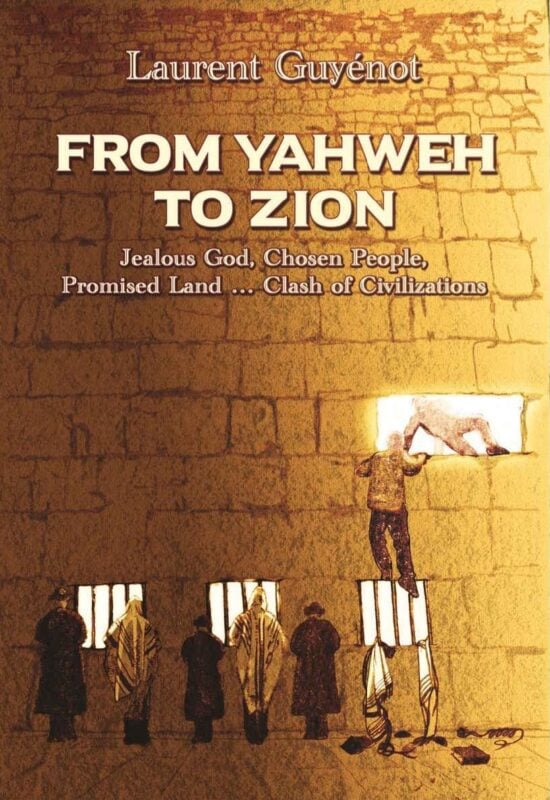
From Yahweh to Zion by Laurent Guyénot traces the evolution of Jewish identity, power, and religious mythology across three millennia, asserting a deep link between ancient narratives and the contemporary reality of Zionism. Guyénot unfolds a story where the formation of a people, a faith, and a political destiny occurs through the calculated interweaving of myth and history, orchestrated by priestly elites and carried forward by modern ideologues. The book roots its analysis in the texts, events, and elite strategies that, together, have shaped both self-perception and global influence.
Origins of Israel: The Birth of a Mythic Nation
The book identifies the formation of ancient Israel as an ideological act, emerging in the late first millennium BCE. Guyénot focuses on the Omrides dynasty in northern Palestine and the evolution of a polytheistic society into one ruled by Yahweh, a deity distinct for his demand of exclusive loyalty. Through the narratives of conquest, exile, and covenant, scribes and priests position Yahweh as both national god and guarantor of ultimate triumph. Deuteronomy and the “Deuteronomic history” cast Israel’s destiny as a unique covenant, promising global dominion in exchange for obedience. The historical Israel, Guyénot claims, absorbs the trauma of conquest by Assyria and Babylon, transforming defeat into divine discipline and future vindication.
Ezra and the Construction of Identity
In the Persian period, Guyénot locates a turning point in the activities of Ezra and Nehemiah. These priestly leaders, returning from Babylon with the support of Persian imperial power, impose a radical new order in Judea. They introduce the Torah as the supreme law, construct a narrative of ancient promises, and establish a theocratic model in which priestly lineage and strict endogamy define community boundaries. The book argues that the Torah itself, including its core laws and stories, emerges at this moment as a tool of elite control. Through rituals, prohibitions, and stories of divine election, these elites engineer a collective memory that overwrites local identities and binds the community to a single, exclusive destiny.
Hellenistic Upheavals and the Hasmonean Synthesis
The encounter with Hellenistic culture intensifies the struggle for Jewish identity. Guyénot examines the Maccabean revolt as a battle between assimilationist currents and fundamentalist reaction, culminating in the rise of the Hasmonean dynasty. These rulers, combining priestly and royal power, expand Judean territory, impose uniform worship, and shape the biblical canon. In this crucible, stories of past glories and persecutions gain new meaning, fueling a militant vision of Jewish destiny and the legitimacy of state violence. The Hasmoneans, while adopting the trappings of Hellenism, reinforce the legal and ethnic exclusivity first instituted by Ezra.
From Sacred Narrative to Political Program
Guyénot follows the migration of these foundational myths into the modern era, where they inform the ideology of Zionism. He details how 19th-century Jewish thinkers, from Moses Hess to Theodor Herzl, drew upon biblical language and symbols to justify a return to the “Promised Land.” Even secular leaders, such as David Ben-Gurion, evoke the prophetic vision of a restored Israel and connect their actions to ancient narratives of conquest and divine favor. The book highlights statements, policies, and even military campaigns shaped by biblical precedents—citing the “Samson Option” for nuclear policy and the continual invocation of Esther and Joshua in political rhetoric.
Zionism and the New Chosenness
As Zionism evolves, Guyénot contends, it merges Jewish identity with loyalty to the modern state of Israel. The narrative of exile and return, central to biblical and rabbinic tradition, becomes the foundation of Israeli national identity. The author asserts that post-Holocaust Jewish consciousness transforms suffering into a secular doctrine of chosenness, cemented by collective memory and reinforced through social and institutional mechanisms. The state becomes the axis of identity, and criticism of its actions is equated with treachery or anti-Semitism. Through this process, traditional religious boundaries give way to political loyalty, enforced by a new elite of secular and religious leaders.
Elite Power and Historical Agency
Central to the analysis is the concept of elite-driven identity. Guyénot assigns agency to religious, cultural, and political elites who craft, adapt, and enforce the collective myths that define Jewishness across eras. These leaders use law, scripture, and narrative as tools of cohesion and separation. The book asserts that the suffering and resilience of the Jewish people, often attributed to inherent qualities or external oppression, arise within a matrix engineered for group survival and dominance. The “Jewish prison”—a metaphor borrowed from Jean Daniel—refers to a structure of identity imposed from above, sustained by cycles of trauma, guilt, and obligation.
The Role of the Bible: Memory, Power, and Justification
Guyénot places the Bible at the heart of this process. The text operates as both portable homeland and charter of exclusive privilege. Biblical stories function as memory devices, encoding lessons of survival, strategies of conquest, and the sanctification of separation. The author insists that the power of the biblical narrative lies in its adaptability—used by priests in ancient times to control populations, by Hasmoneans to justify expansion, and by modern Zionists to legitimate statehood and military action. This dynamic process, repeated through centuries, secures the continuity of Jewish identity even as circumstances change.
Modernity, the Holocaust, and Ideological Renewal
The trauma of the Holocaust, Guyénot argues, provides a new secular foundation for Jewish identity. The memory of destruction and survival, enshrined in museums, education, and public discourse, reinforces the sense of collective destiny and vulnerability. The book describes the Holocaust as a new “myth of election,” shifting the locus of chosenness from divine covenant to historical suffering. This memory, institutionalized in Israel and the diaspora, serves both to unify and to silence dissent, shaping foreign policy and public debate around the world.
The Structure of Power and the Question of Critique
Guyénot examines the mechanisms that insulate these narratives from critique. Social, academic, and legal constraints restrict discussion of Jewish power and the ideological basis of Zionism. The equation of anti-Zionism with anti-Semitism, promoted by official bodies and cultural elites, consolidates this immunity. The book warns that such prohibitions foster resentment and misunderstanding, inhibiting open debate and critical scholarship. Guyénot proposes that only by dismantling these barriers—by exposing the elite manipulation of identity and myth—can societies move toward genuine dialogue and mutual understanding.
Beyond Identity: Agency, Responsibility, and Liberation
The author calls for a reexamination of Jewishness, not as an immutable essence, but as a system of ideas subject to critique and transformation. By focusing on beliefs, representations, and ideological frameworks, he seeks to separate individual agency from elite-driven structures. Guyénot maintains that the first victims of exclusionary ideologies are those who internalize them, and that liberation requires cognitive empathy and historical clarity. This argument extends to all forms of tribalism and ideological closure, asserting the possibility of escape and renewal through critical thought.
The Global Impact of a Local Narrative
Guyénot extends his analysis to the influence of Jewish ideas and elites on world history. He claims that the dynamic interplay between Jewishness and surrounding cultures has driven significant changes, often through conflict and antagonism. The cycles of dispersion, adaptation, and assertion recur in new forms—through the Spanish expulsions, the Marrano diaspora, the rise of Ashkenazi influence, and the American century. The book posits that the struggle for identity and dominance, born in ancient Israel, shapes the political and cultural landscape of the modern world.
The Evolution of Leadership and the Future of Identity
Guyénot identifies a historical pattern: dominant elites use myth and memory to construct group cohesion, justify privilege, and direct collective action. As circumstances shift—from Persian patronage to Roman rule, from medieval Christendom to modern nation-states—the strategies of survival and assertion evolve. The author contends that present-day Jewish elites continue this tradition, fusing ancient and modern tools to sustain their authority and direct communal destiny.
Conclusion: Reassessing Myth, Power, and History
From Yahweh to Zion closes with a call to critical inquiry and open debate. The book insists that understanding Jewish identity, Zionism, and their global effects demands engagement with the ideological and historical mechanisms of mythmaking and elite control. Guyénot situates his critique within a tradition of scholarship that recognizes both the dangers and the creative potential of strong collective identities. He challenges readers to question received narratives, confront taboos, and acknowledge the agency of those who construct history. In doing so, the book posits that the convergence of myth, memory, and power continues to shape the destiny of peoples and nations, and that the future depends on our capacity for honest reckoning with the past.