Weimar on the Pacific: German Exile Culture in Los Angeles and the Crisis of Modernism
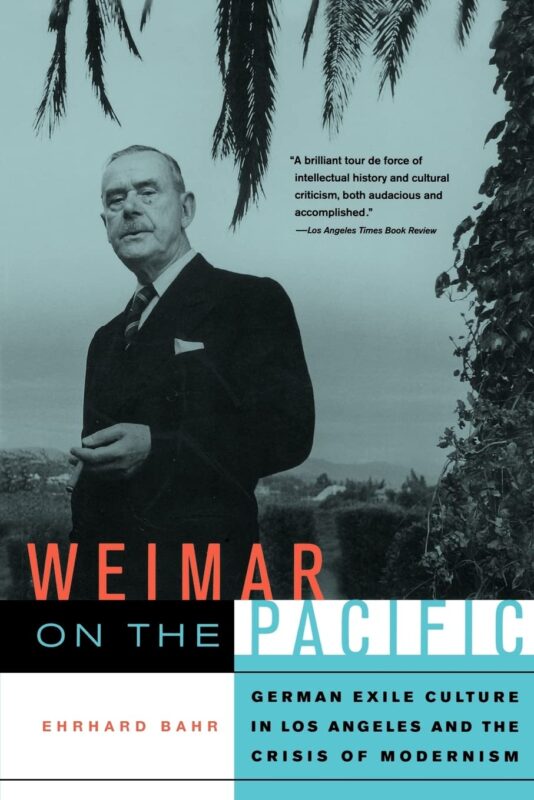
Weimar on the Pacific: German Exile Culture in Los Angeles and the Crisis of Modernism by Ehrhard Bahr reconstructs the transformation of Los Angeles into a singular epicenter of German intellectual and artistic life in the 1930s and 1940s. Bahr asserts that Los Angeles, animated by an influx of German-speaking refugees, embodied a convergence of aesthetic innovation, philosophical debate, and political urgency that reverberated through the city’s cultural landscape. By situating the story within the lived experience of exile and the legacy of Weimar modernism, Bahr identifies how the disruption of totalitarian violence catalyzed a renewed search for meaning, identity, and creative agency among displaced writers, musicians, filmmakers, architects, and philosophers.
A City Between Arcadia and Utopia
Los Angeles occupies a paradoxical position in the imagination of both Americans and European exiles—a territory oscillating between visions of paradise and projections of boundless possibility. Bahr traces how myths of an acquired Arcadia and an invented utopia shape the city’s cultural resonance, often masking deeper realities beneath the surface of entertainment and development. When German-speaking émigrés arrived, they encountered a city celebrated for its palm-lined avenues, cinematic dreams, and open landscapes. Yet these exiles—among them Thomas Mann, Bertolt Brecht, Arnold Schoenberg, Lion Feuchtwanger, Alfred Döblin, and Franz Werfel—imported a legacy of cultural gravitas and intellectual pursuit rooted in the tumultuous history of Weimar Germany.
Flight from Persecution and the Geography of Exile
The Nazis’ systematic assault on artistic and intellectual freedom forced a generation of German writers, musicians, filmmakers, and academics into exile. Los Angeles, with its promise of safety, employment opportunities in the film industry, and an established German-speaking community, became a crucial refuge. Between 1933 and 1941, Southern California received between 10,000 and 15,000 German-speaking refugees, the majority of whom were Jewish. For these émigrés, the transition entailed not only geographic displacement but also the challenge of adapting their work to a new environment, reconstructing creative communities, and redefining the role of art in the face of crisis.
The Dialectic of Modernism and the Exile’s Creative Response
Bahr locates the center of gravity in the crisis of modernism provoked by the rupture of 1933. Modernism, as conceived by its champions, had promised transformation—social, political, and aesthetic. The rise of fascism exposed the fragility of this vision. The experience of exile forced German intellectuals to interrogate their aesthetic practices, question the efficacy of utopian art, and confront the historical conditions that shaped both their creative output and their political commitments. Los Angeles became a laboratory for this dialectic, producing works that oscillate between hope and despair, nostalgia and experimentation.
Institutions and the Fabric of Exile Culture
German-speaking exiles sought out both formal and informal networks in Los Angeles. Institutions such as the University of California, Los Angeles (UCLA) and the University of Southern California (USC) provided employment and resources for prominent scholars and artists, including Arnold Schoenberg and Hans Reichenbach. Yet Bahr observes that the heart of the exile community lay in clubs, newspapers, theaters, and private gatherings—the Jewish Club of 1933, the newspaper Aufbau, and local theaters became nodes of cultural continuity and adaptation. Exile artists and intellectuals cultivated an environment in which German language, literature, and debate persisted alongside and within American society.
Hollywood, Anti-Fascism, and Political Engagement
Many exiles gravitated to Hollywood, drawn by the motion picture industry’s economic opportunities and its reputation for progressive politics. Organizations such as the Hollywood Anti-Nazi League (HANL) coordinated cultural and political activism, sponsoring events, supporting the Spanish Republic, and forging alliances between European émigrés and American progressives. The artistic output of exiles like Brecht, who wrote for the stage and screen, and Fritz Lang, who directed anti-Nazi films, illustrates the intersection of creativity and resistance.
The Plurality of Modernisms: Innovation and Memory
Exile did not produce a monolithic cultural response. Bahr identifies multiple trajectories within modernism as it migrated to Los Angeles. Writers, architects, and composers confronted the task of preserving the experimental energy of Weimar culture while responding to the historical rupture imposed by fascism and displacement. Some, like Thomas Mann, reflected on the loss and transformation of German identity in novels and essays. Others, including Brecht, Schoenberg, and the architects Richard Neutra and Rudolph Schindler, engaged with the forms and technologies of their adopted city, embedding their works within the American landscape. The result was a dynamic interplay between memory and innovation, continuity and reinvention.
Community, Assimilation, and the Everyday
Bahr addresses the structure of daily life within the exile community. The majority of German-speaking refugees prioritized assimilation into American society, especially among Jewish émigrés who sought safety and stability. Yet, the programs and activities of the Jewish Club of 1933, theatrical performances, musical evenings, and literary readings created spaces where German language and culture flourished. The boundaries between exile and host society were both porous and contested, as the émigrés navigated professional integration, social mobility, and the persistence of cultural heritage.
The Role of the German-Language Press
German-language newspapers and journals in Los Angeles reflected the spectrum of political and cultural positions within the exile community. The Aufbau, published in New York but distributed widely in California, advocated for the cultivation of German cultural tradition, loyalty to the United States, and connection to Jewish identity. Other publications, such as the California Staatszeitung and the Sued-California Deutsche Zeitung, articulated more conservative or even pro-Nazi viewpoints. The existence of these divergent voices shaped debates over identity, belonging, and the legacy of German culture in exile.
Art, Architecture, and the Reimagining of Space
Bahr explores the influence of exile on architecture and visual culture. Richard Neutra and Rudolph Schindler, both Austrian-born architects, contributed to the emergence of California modernism, infusing local design with European avant-garde principles. Their work, alongside the residential and artistic projects of émigré intellectuals, transformed the built environment of Los Angeles. The city’s gardens, houses, and public spaces became sites of negotiation between old world aesthetics and new world possibilities. Visual artists, photographers, and designers further enriched this convergence, leaving an imprint that extended beyond the exile generation.
The Transmission of Intellectual Traditions
Philosophers and social theorists, including members of the Frankfurt School, confronted the challenge of sustaining rigorous intellectual inquiry in exile. The University in Exile at the New School for Social Research in New York provided an institutional anchor for scholars from the Frankfurt School, while Los Angeles offered a looser network of salons, lectures, and collaborations. Bahr traces the interplay between German philosophical traditions and the American context, revealing how exile both preserved and transformed critical theory.
Music, Performance, and Cultural Adaptation
Music functioned as both a vehicle for cultural memory and a means of adaptation. Arnold Schoenberg, the pioneer of twelve-tone composition, established himself in Los Angeles and influenced American music education, performance, and composition. Concerts, operas, and chamber music events organized by émigré musicians created audiences for works that bridged German and American sensibilities. The creative exchange between exiles and local artists fostered new genres, hybrid forms, and expanded the reach of European modernism.
The Politics of Memory and the Construction of Legacy
Bahr interrogates the ways in which the exile community constructed and mythologized its own legacy. The idealization of the Weimar Republic—the so-called “legend of Weimar”—infused the narratives of exiles who remembered their lost homeland as a site of creative ferment and democratic aspiration. Yet, this memory coexisted with a recognition of the contradictions, anxieties, and failures that had plagued Weimar culture. The exile’s position at the crossroads of destruction and renewal intensified the stakes of cultural production and the urgency of memory work.
Cultural Rupture and the Question of Audience
The Nazi regime’s assault on culture prompted a mass exodus of writers and artists. In Los Angeles, the audience for German exile culture consisted largely of fellow émigrés and local supporters. Bahr scrutinizes the tension between esoteric art, directed toward an elite, and efforts to reach broader publics through translation, adaptation, and collaboration. The exile’s quest for recognition and the drive to preserve a distinctive German voice informed artistic choices and shaped the contours of cultural transmission.
Global Impact and the Resonance of Exile
The convergence of German-speaking exiles in Los Angeles produced lasting effects on the city’s cultural identity and the trajectory of modernism worldwide. Works created in exile influenced literature, music, theater, and architecture far beyond Southern California. Bahr identifies the export of exile modernism as both a triumph of creative resilience and a case study in the complexities of cross-cultural transmission. The works of Mann, Brecht, Schoenberg, Neutra, Schindler, and their contemporaries serve as enduring testaments to the possibilities of artistic renewal under conditions of rupture and displacement.
Weimar on the Pacific as a Site of Dialectical Tension
Bahr positions Los Angeles as a city of dialectics, where the tension between old and new, nostalgia and futurity, utopia and crisis animates cultural production. Exile did not erase the trauma of loss, nor did it guarantee the simple transplantation of Weimar modernism. Instead, the interplay between environment, history, and artistic agency produced a distinctive modernism—marked by fracture, self-reflection, and experimentation. The exile’s confrontation with Los Angeles’s landscapes, institutions, and publics generated creative energies that contributed to the city’s evolution as a center of international art and thought.
Modernism’s Crisis and the Redefinition of Cultural Purpose
The central question—how can art and intellect respond to catastrophe and remake meaning?—runs through Bahr’s account. Exile compelled German modernists to confront the limits of their previous assumptions and to seek new answers through dialogue, collaboration, and formal innovation. The crisis of modernism became an engine for transformation. In Los Angeles, the émigrés did not merely seek refuge; they redefined the relationship between artist and society, reimagined the boundaries of their disciplines, and participated in the global movement of ideas and forms.
Cultural Adaptation, Identity, and the Work of Transmission
Bahr underscores the complexity of assimilation and the persistence of cultural identity within the exile community. The negotiation between American expectations and German traditions shaped personal, artistic, and institutional trajectories. The creative legacies forged in Los Angeles outlasted the generation of exiles, influencing American culture, the ongoing history of modernism, and the memory of a remarkable chapter in twentieth-century history.
Conclusion: The Enduring Significance of Exile Modernism
Weimar on the Pacific: German Exile Culture in Los Angeles and the Crisis of Modernism reveals how the confluence of history, migration, and creativity transformed Los Angeles into a crucible of modernist innovation and cultural memory. Bahr demonstrates that the crisis of modernism, far from signaling an endpoint, became a catalyst for new forms, meanings, and solidarities. The book stands as both a historical account and an analytical reflection on the power of exile to generate cultural renewal, the challenges of transmission across languages and borders, and the ongoing relevance of Weimar modernism in a globalized world. The story of German-speaking exiles in Los Angeles embodies the resilience of artistic vision and the transformative possibilities of cultural encounter, shaping the city and its legacy for generations.