Servitors of Empire: Studies in the Dark Side of Asian America
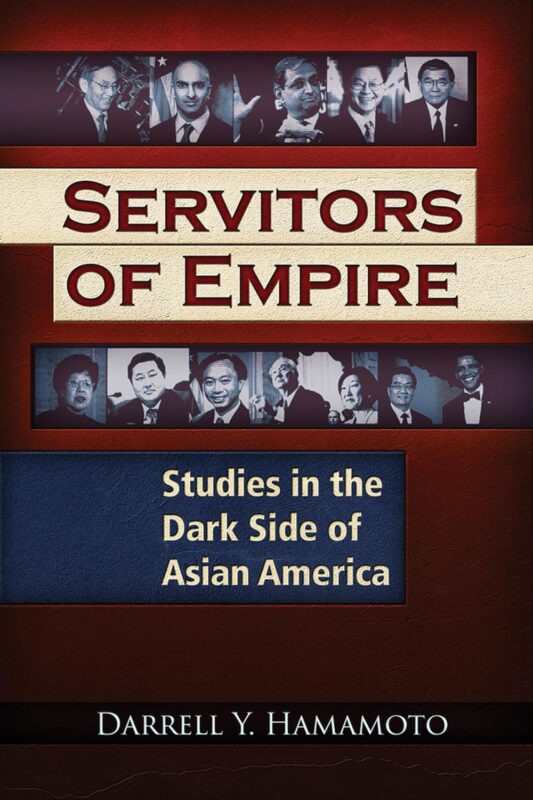
Servitors of Empire by Darrell Hamamoto exposes the racialized politics embedded within U.S. media and academia through a rigorous analysis of Asian American figures who perpetuate imperial ideologies.
Hamamoto asserts that Asian Americans, often perceived as politically passive or disconnected from imperial narratives, have in many cases served as critical functionaries in the maintenance of empire. These individuals, situated within media, academia, and policy sectors, act not as subversive critics but as agents of dominant power structures. The book opens with a confrontation: how does a minority group historically positioned as “model” in the racial hierarchy reconcile its participation in oppressive statecraft? The chapters pursue this question through meticulously documented case studies of prominent Asian American intellectuals, journalists, and media professionals.
Empire as a structural framework
Hamamoto treats the American empire not as a metaphor but as a material and institutional reality. He outlines its architecture: military dominance, economic control, cultural hegemony, and ideological propagation. Asian Americans, he argues, do not operate outside of this architecture. Instead, they have been integrated as ideological laborers who help sustain empire by managing perceptions, manufacturing consent, and neutralizing dissent. The book's structure mirrors this framework, organizing its analysis around distinct institutional nexuses—universities, newsrooms, think tanks—each representing a node of empire.
The ideological role of Asian American academics
The university system appears early in Hamamoto’s critique. He focuses on scholars who, while ostensibly advancing ethnic studies or progressive politics, ultimately reinforce the state's legitimacy. Hamamoto critiques figures like Gordon Chang and others for embedding state-sanctioned narratives into ethnic studies discourse, reducing complex geopolitical realities to binary moralisms. Through citation analysis and institutional tracing, he demonstrates how certain Asian American scholars function as legitimizers of U.S. foreign policy. Their academic work becomes a site not of resistance, but of soft power reinforcement.
Journalism as imperial instrument
The next analytical vector is media. Here, Hamamoto investigates journalists who purport to represent minority perspectives while operating within elite media institutions like the New York Times or CNN. He dissects the work of reporters who shape narratives about China, the Middle East, or U.S. domestic racial tensions in ways that reflect national security priorities rather than independent critique. By aligning with dominant discourses, these journalists become interpreters of empire to both the majority and minority populations. Their authority derives not from community embeddedness but from institutional validation.
Popular culture and affective conditioning
Hamamoto expands the scope to entertainment and popular culture, examining how Asian American figures in film and television produce and circulate affective narratives aligned with imperial desire. He explores casting choices, script constructions, and character arcs, showing how Asian Americans are positioned to reassure audiences of U.S. benevolence or superiority. This section draws heavily on media theory, combining psychoanalytic insights with historical contextualization. Representation becomes less a matter of inclusion than a process of ideological grooming.
Discipline and co-optation in the state apparatus
The final chapters turn to direct state affiliation. Hamamoto traces how some Asian Americans enter the military-industrial complex, foreign service, or intelligence sectors. These individuals often invoke identity to justify participation, claiming a special capacity to mediate between cultures or act as ethical actors within compromised systems. Hamamoto challenges these justifications as forms of co-optation, arguing that identity here functions as camouflage for complicity. Through this lens, multiculturalism is revealed as an instrument of operational diversity, not democratic deepening.
Refusing assimilationist paradigms
At the conceptual core of the book lies a powerful refusal: Hamamoto denies the premise that upward mobility equals liberation. He critiques civil rights paradigms that celebrate representation within existing institutions as signs of progress. Instead, he insists on structural transformation that begins with a clear-eyed confrontation of how empire works and who serves it. This position marks a divergence from mainstream Asian American studies, which often seeks to reconcile identity with citizenship rather than interrogate the foundations of that citizenship.
Reconstructing political consciousness
Hamamoto’s project is reconstructive as much as it is critical. He calls for a revitalized political consciousness among Asian Americans—one that does not rest on the laurels of professional achievement or institutional inclusion. He proposes a new intellectual and cultural orientation that prioritizes anti-imperial solidarity, systemic critique, and historical memory. This includes recovering traditions of radical thought from Asian diasporic communities and fostering independent media and educational initiatives.
Narrative form and theoretical method
The book refuses a purely empirical approach. Hamamoto weaves theory with narrative, analysis with anecdote. He employs cultural criticism, psychoanalysis, political economy, and historical materialism, allowing insights to accumulate through layered engagement rather than linear argumentation. The style demands attentiveness but rewards with depth. It rejects the academic convention of neutrality, choosing instead a position of intellectual insurgency.
A call to realign allegiance
Servitors of Empire issues a call. Not to loyalty, but to disloyalty—against empire, against co-optation, against institutional flattery. It urges readers to trace the lines of power that run through identity, profession, and public discourse. The book destabilizes comfort and challenges pride. In doing so, it opens a space for reckoning and reorientation. Asian American identity, Hamamoto argues, cannot be a sanctuary from history; it must become a site of its transformation.
Embedded responsibility
Responsibility threads the book. Hamamoto does not accuse from a distance. He implicates himself, his peers, his institutions. The critique is not voyeuristic but participatory. It assumes that readers are not spectators but potential agents. The writing builds a scaffold for action, rooting insight in accountability. The text insists that understanding empire requires interrogating how we live, speak, teach, and narrate within its architecture.
Asian America as a contested terrain
This is not a treatise on betrayal. It is an anatomy of a formation. Hamamoto’s object is not individual moral failure, but structural positioning. Servitors of Empire reveals Asian America as a terrain shaped by forces that both empower and conscript. It invites those within it to choose their orientation—toward empire, or against it. This choice is not symbolic. It defines how knowledge is produced, circulated, and contested. It shapes the future of political community.


https://youtu.be/ia9Lg3ZHBjE